Diastasis Recti in Pregnancy: Exercises for Prevention and Recovery
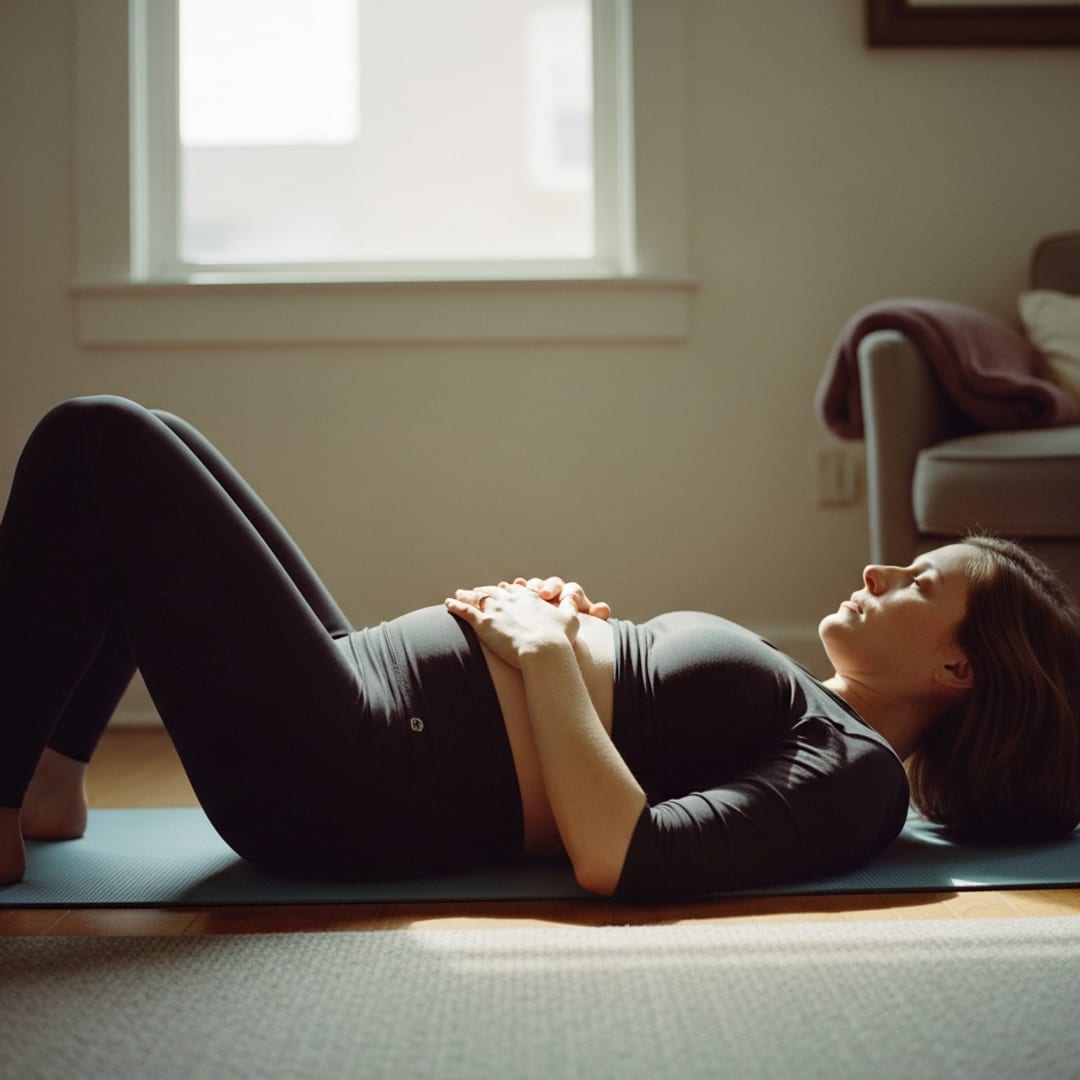
Have you noticed an unusual "doming" in your belly when you sit up from lying down, or a soft, gap-like feeling between your abdominal muscles after giving birth? Fear of diastasis (separation of the abdominal muscles) is extremely common among pregnant women and new mothers, but it's important to say this clearly from the start: your body is not broken.
As certified kinesiologists with years of experience in prenatal and postnatal training, we help women navigate these physical changes safely and without fear every day. The separation of the abdominal muscles is a natural, physiological process that gives your baby room to grow. With the right exercises and movement awareness, you can preserve your core's function and speed up your recovery afterward.
What diastasis actually is, and why it's normal in pregnancy
To understand diastasis (Latin: diastasis recti abdominis), we need to look at the anatomy of your torso. The front of the abdominal wall is made up of the rectus abdominis, known as the "six-pack" muscle. It consists of a left and right half, connected in the middle by a firm, elastic band of connective tissue called the linea alba (white line).
During pregnancy, under the influence of hormones (mainly relaxin and estrogen) that soften connective tissue, and due to the constantly growing uterus, the linea alba stretches and thins. This allows the left and right sides of the muscle to move apart to make room for the baby.
According to guidelines from respected gynecological associations, including the American College of Obstetricians and Gynecologists (ACOG), abdominal muscle separation in the third trimester occurs in nearly 100% of pregnant women. This isn't a pathology or an injury. It's a brilliant adaptation of the female body, and the problem only arises when that separation stays excessively wide and non-functional for months after birth, which can lead to lower back pain, pelvic instability, or postural issues.
How to check for diastasis: a simple self-test at home
While the most accurate diagnosis is made by ultrasound or palpation by a professional, you can do a simple self-check at home. If you're in the postpartum period (the first 6 weeks), keep in mind that the tissue is still naturally soft and your body is recovering intensively, so do this test without pressure or rushing.
Here's how to check for diastasis in a few simple steps:
- Lie on your back with your knees bent and feet flat on the floor.
- Place one hand behind your head for support, and the fingers of your other hand vertically across the middle of your belly, just above your belly button.
- Gently lift your head and shoulders off the floor (as if doing a light crunch) just enough for the abdominal muscles to lightly tense. Don't lift your whole torso.
- Press gently down with your fingers. Check how many fingers' width fit into the gap between the left and right sides of the muscle.
- Repeat at three points: right at the belly button, 3–5 cm above it, and 3–5 cm below it.

If you want a guided version, try our free diastasis self-check.
Besides the width of the gap itself (measured in centimeters or finger-widths), the depth and tension of the tissue (the linea alba) is extremely important. If your fingers sink in deeply with no resistance, the connective tissue has lost its tension. If you feel firm resistance (like a taut trampoline), that's a great sign that your core function, despite any gap, is well preserved.
Also pay attention to any "doming" or "coning" along the midline of your belly during everyday movements like getting out of bed or lifting something. That's a clear sign that internal abdominal pressure isn't being distributed properly and is loading the connective tissue.
Preventing diastasis during pregnancy
While we can't fully prevent the natural stretching of tissue that comes with carrying a baby, we can drastically reduce the load on the linea alba and prevent excessive separation of the abdominal muscles in pregnancy. The key to prevention lies in managing intra-abdominal pressure and avoiding movements that push the belly "outward."
- Getting out of bed properly: Never sit straight up from lying flat. Instead, always roll onto your side first, lower your legs over the edge of the bed, and push yourself up into a sitting position with your arms.
- Breath control: Avoid holding your breath when lifting a load (like an older child or grocery bags). Always exhale at the moment of greatest effort; exhaling naturally activates your deep core stabilizers.
- Good posture: Avoid excessively tipping your pelvis forward (anterior pelvic tilt) and "hanging" on your back ligaments, which further stretches the front abdominal wall. Try to keep your pelvis in a neutral position.
For a detailed look at safe movement patterns and structured training, we warmly recommend reading our complete guide to exercising during pregnancy. Also, don't forget that your abdominal muscles are inseparably connected to the base of your core. Proper activation and release of the muscles that hold your pelvic floor play a key role in maintaining optimal pressure in the abdominal cavity.
Safe and effective diastasis exercises
When we talk about "diastasis exercises," the focus shouldn't be on simply "closing the gap," but on restoring the function, strength, and synergy of your whole core. The following exercises are safe to perform during pregnancy (with your doctor's approval) and as diastasis exercises after birth.
1. Diaphragmatic breathing with transversus activation (3D breathing)
This is the foundation of any rehabilitation. The deep transverse abdominal muscle (transversus abdominis) acts like a natural corset that wraps around your core and stabilizes it.
- Sit upright on a chair or ball, or lie on your back with your knees bent.
- Inhale deeply through your nose, directing the air into your lower ribs and belly (the ribs expand sideways and back, and the belly rises slightly).
- As you exhale through slightly parted lips, imagine gently drawing your belly button toward your spine and "hugging" your baby with your abdominal muscles, while lightly lifting your pelvic floor muscles at the same time.
2. Bird-Dog
An excellent exercise for core stabilization and strengthening the posterior chain without loading the front abdominal wall.
- Get into a hands-and-knees position (hands under shoulders, knees under hips).
- Keep your spine neutral, gaze toward the floor.
- On an exhale, with your core engaged, slowly extend the opposite arm and opposite leg until they're in line with your body.
- Make sure your lower back doesn't arch and your belly doesn't sag toward the floor. Return to the start with an inhale and repeat on the other side.
3. Modified Dead Bug on the floor
Instead of the classic version, which can be too demanding for a weakened core, we use a safe modification that protects the abdominal wall.
- Lie on your back, knees bent at 90 degrees, feet flat on the floor. Extend your arms toward the ceiling.
- On an exhale, slowly slide one heel forward along the floor until the leg is fully extended, keeping your back stable and not letting your belly bulge upward.
- Return the leg on an inhale and repeat with the other leg.
4. Side plank: kneeling progressions
The side plank activates the oblique abdominal muscles, which help stabilize the core, without creating the direct pressure on the linea alba that a classic front plank does.
- Rest on your forearm and knees, keeping your body in a straight line from head to knees.
- Lift your hips off the floor and hold the position with calm, deep breathing.
- If you feel any shaking or can't control your breath, shorten the hold time and gradually build endurance.
What to definitely avoid
If you have diastasis or want to prevent it, certain movements can significantly worsen the condition by stretching already-weakened connective tissue. Avoid the following activities:
- Classic crunches and sit-ups: These directly push your organs and pressure forward, causing doming down the middle of your belly and further separating the muscles.
- Classic planks on hands and toes: If your deep core isn't yet strong enough to bear your body weight against gravity, your belly will "sag" and create huge pressure on the linea alba.
- Deep torso rotations and sudden twisting movements: These movements can further stretch and load the side seams of the abdominal muscles at moments when they lack stability.
- Lifting heavy loads while holding your breath (Valsalva maneuver): This creates uncontrolled pressure inside the abdominal cavity that seeks out the "weakest point," which in this case is your diastasis or pelvic floor.
Want a safe, expertly guided training plan tailored to your body? Every pregnancy and every postpartum recovery is unique. Have our certified kinesiologists assess your body's current state and create a personalized training program that rebuilds your core strength. Fill out our short questionnaire and get started today.
Postpartum recovery and realistic timelines
Once your baby arrives, it's natural to want your body back in shape as soon as possible. It's important, however, to give your body time to regenerate. The first 6 to 8 weeks after birth (the postpartum period) is reserved for rest, bonding with your baby, and gentle, restorative breathing that encourages the natural contraction of the uterus and abdominal muscles.
During this period, the tissue recovers significantly on its own under the influence of natural hormonal shifts. Only after your first postpartum checkup and getting the "green light" from your doctor can you slowly introduce more structured postpartum recovery.
Diastasis healing isn't linear and doesn't happen overnight. In some women, significant improvement in tissue tension is visible after just 8 to 12 weeks of consistent, targeted work, while more pronounced separations require several months of work (sometimes up to a year). Be patient with your body. It created a new life over nine months and went through incredible changes.
⚠️ When to stop exercising and seek professional help If during any exercise you notice a pronounced cone-shaped bulge along your belly that you can't control with your breath, stop that exercise immediately and modify it. Also, if you feel sharp pain around your belly button (which may indicate a hernia), pressure, or urine leakage under exertion, or if the gap doesn't shrink even after months of targeted exercise, be sure to see a pelvic-health physical therapist or your gynecologist.
Frequently asked questions about diastasis
Does diastasis close on its own after birth?
Partly, yes. During the first few weeks after birth, your body goes through a phase of natural healing and the tissue spontaneously contracts. For many women, however, spontaneous recovery stalls around the eighth week postpartum. After that, targeted work and deep-core activation through tailored exercises are needed to restore optimal connective-tissue tension and muscle function.
Am I allowed to plank if I have diastasis?
A classic plank on forearms and toes isn't recommended in the early stages of recovery because gravity pulls your abdominal organs downward, creating too much pressure on a weakened linea alba. Instead, start with an elevated plank (e.g., against a wall or the edge of a table) or a kneeling side plank, always watching how your abdominal wall behaves. If doming appears, the exercise is currently too demanding for your core.
When am I allowed to start exercising after birth?
You can start light breathing exercises and mindful pelvic floor activation just a few days after an uncomplicated vaginal birth, as long as it's completely pain-free and comfortable. For more intensive, structured strength and core recovery exercises, you should wait for your routine postpartum checkup (usually 6 weeks after a vaginal birth, or 8 to 12 weeks after a C-section) and your gynecologist's official approval.
Remember, diastasis isn't an aesthetic verdict or permanent damage. It's a functional challenge that can be successfully resolved with patience and a smart approach to training. Listen to your body, avoid sudden movements, and build strength from the foundation outward. Your body has an incredible capacity for regeneration, and we're here to give you safe, expert support along the way.

MyFittio Team
NEPPE Certified Kinesiologists
Expert team of kinesiologists specialized in prenatal and postnatal programs, and body transformations. Our mission is to provide safe, science-backed support through every step of your health journey.
Your body is more complex than any calculator
A certified kinesiologist analyzes your unique situation and builds a program that actually works for your body type, lifestyle, and goals.
30-day money-back guarantee
You might also like
Pregnant, postpartum, diastasis or back pain: why most online programs do not want you, and what to do instead
There are 300 women on the stream. One of them is doing crunches with diastasis recti, and nobody knows.