Postpartum Recovery: When Is It Safe to Start Exercising?
Social media today is flooded with fitness influencers who are back in their "pre-pregnancy shape" just a week or two after giving birth. That deeply unrealistic, polished image creates enormous pressure on new mothers, while at the same time promoting potentially very dangerous physical practices.
Your body has just been through one of the most intense physical, hormonal, and emotional processes in nature. Rushing back to heavy weights, running, and sit-ups isn't bravery; it's a kinesiological risk to the long-term health of your pelvis. That's why at MyFittio we live by one golden rule: recovery is not a race.
As NEPPE-certified specialists, here's our comprehensive, science-based guide to a safe, functional return to training after birth.
1. Recovery is not a race: the 6-week rule
Rushing back into an intense training routine is often a recipe for disaster. Pushing your body past its limits before connective tissue has regenerated can lead to pelvic organ prolapse (organs descending through the vaginal canal), urinary incontinence, or a permanent worsening of abdominal diastasis.
According to guidelines from leading gynecological associations, the first and most important step before any serious training planning is a 6-week checkup with your gynecologist.
Until your doctor confirms that your wounds (whether from a C-section, episiotomy, or tears) have fully healed and that it's safe to start physical activity, your only responsibilities are:
- Short, easy walks, up to 15 minutes.
- Diaphragmatic breathing exercises in bed.
- Rest, bonding with your baby, and establishing a breastfeeding/feeding rhythm.
Need an individualized plan for a safer recovery? Don't leave it to chance: fill out the MyFittio postnatal questionnaire and our specialists will prepare a program aligned with both your physical condition and your doctor's approval.
2. What actually happened to your body? Postpartum anatomy
To make room for a growing baby and ultimately deliver it, your body had to adapt dramatically over nine months. Ignoring those adaptations means going into training with your software's "old settings" on completely different hardware.
There are three main regions we pay attention to postpartum:
- The abdominal wall (core): Your abdominal muscles, and especially the connective tissue (linea alba) between them, stretched to their maximum, which in nearly all women results in a physiological separation of the muscles known as diastasis recti. Rushing back into standard sit-ups (crunches) will only increase intra-abdominal pressure and push the tissue further outward, worsening the condition.
- Pelvic floor muscles: These muscles carried the incredible weight of the baby, placenta, and amniotic fluid for months. In vaginal birth, they went through enormous tension (and often trauma); in a C-section, they bear compensatory pressure from the abdominal incision. For more on breathing and diaphragm recovery, see our article on the importance of the pelvic floor.
- Changed postural mechanics: Your pelvis is likely still tilted slightly forward, your upper back (thoracic spine) is rounded from carrying the baby, and your chest muscles are shortened from breastfeeding.
Think of this not as "permanent damage" but as a natural adaptation. Still, just like an athlete's injury on the field, it requires smart, structured sports rehabilitation.
Before the details, here is the whole path in one place:

3. Phase 1: Rebuilding from the inside out (weeks 6 to 12)
When you finally get the green light to return to activity and start a MyFittio program, the first 3 to 4 weeks might not look like the training you're used to at all. And that's exactly what your body needs.
In this sensitive phase, we focus explicitly on re-establishing neurological control over muscles that have "forgotten" their function. Our approach includes:
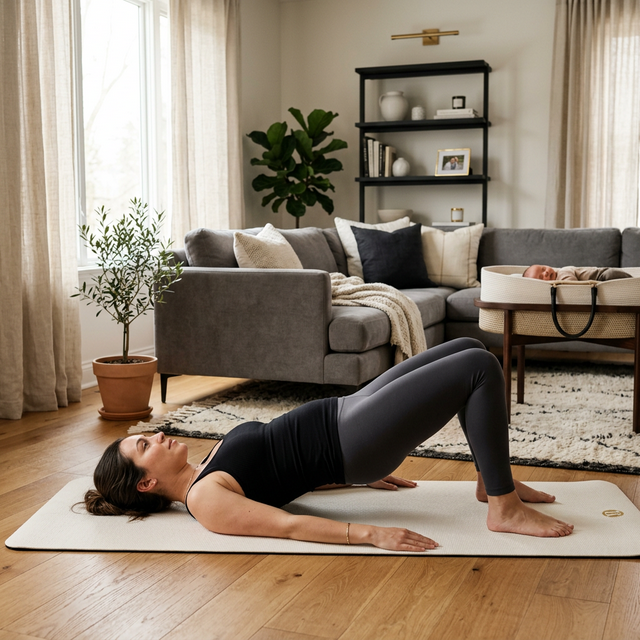
- Diaphragmatic breathing (360 breathing): Learning to use your diaphragm to breathe and expand your ribs in every direction (forward, back, sideways), which naturally regulates pressure inside your abdomen.
- Mind-muscle connection (TVA activation): Finding the deep transverse abdominal muscle (Transversus Abdominis), which acts as a natural corset, and gently syncing its contraction with lifting (not squeezing!) the pelvic floor muscles on the exhale.
- Gentle joint activation with no pressure on scar tissue: In this phase, there are no sit-ups, planks, or jumps of any kind. All exercises are done primarily lying down with no load on the abdomen, stabilizing the lumbar spine.
Not sure if you have diastasis and which exercises are safe for you? Work with real, expert support. In live sessions, we test your abdominal wall with you and build specific corrective exercises. Sign up now.
4. Phase 2: Gradual return of strength (12+ weeks)
Once we've established a functional core that manages pressure well without leaking urine or bulging at the belly, we start building the strength your body needs for the demands of motherhood. Babies get heavier fast, and car seats and pushing strollers uphill require serious back and arm strength!
This is the phase where we gradually introduce:
- Functional lunges and rotations to strengthen your hips.
- Rowing and back exercises to stretch a chest shortened by long periods of breastfeeding and rounded posture.
- Farmer's carries and unilateral strength exercises to stabilize the pelvis in a safe, controlled way.
- Gentle aerobic activity, along with symptom monitoring.
For any increase in load, we follow one key rule: Close your eyes. Do you feel dull pressure in the vagina, involuntary urine leakage, or notice doming down the middle of your belly while exercising? If the answer is yes, the load is too much right now. You need to reduce the weight, reduce the range of motion, or choose a simpler regression of the exercise.
If you're not sure how to adjust this on your own, read the article Online coach vs. fitness apps and find out why an algorithm can't spot your compensation through a screen.
5. Why general fitness programs don't work for postpartum women
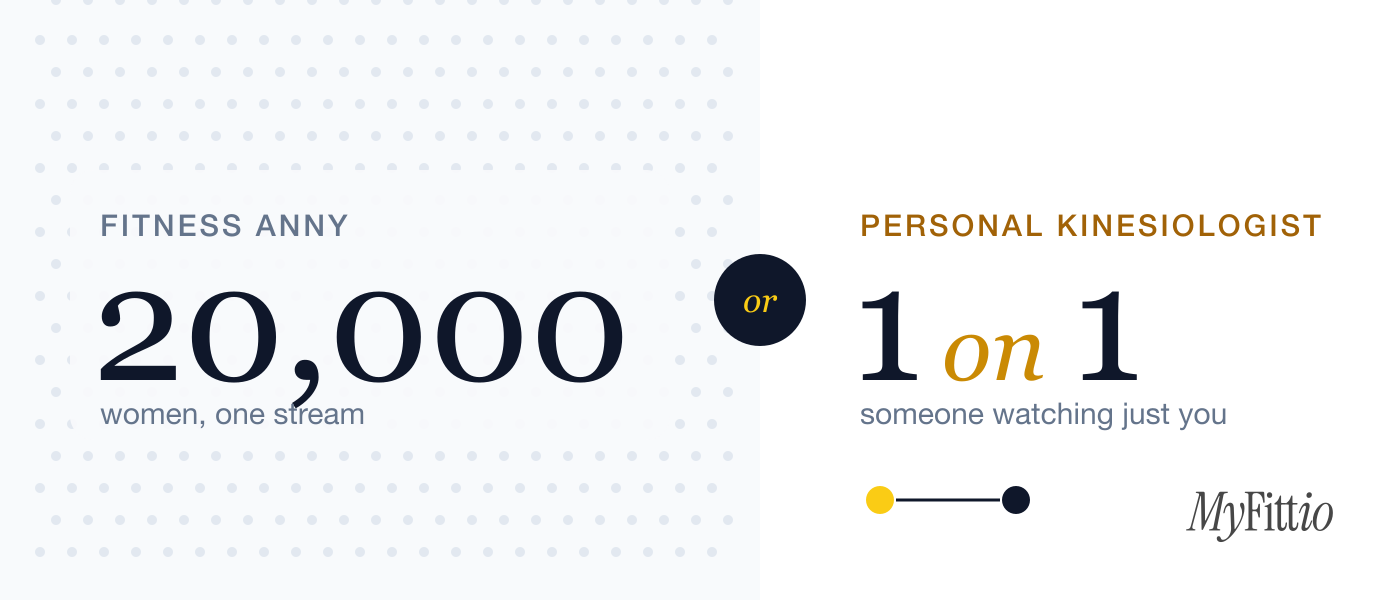
Many new mothers try to get back in shape using free YouTube videos, high-frequency group classes (like Zumba, boot camp, or aerobics), or standard "burn fat fast" fitness apps. That's where the real danger lies.
First, a YouTube instructor can't see you through the screen. They don't know whether you're doing an exercise with "kinesiological over-compensation" (your body unconsciously using the wrong, uninjured muscles while the stretched or injured one stays inactive).
Second, group classes offer a one-size-fits-all model. There's absolutely no adjustment of pace or exercise if your perineum's episiotomy hasn't healed enough yet for you to safely do jumping lunges. Your postnatal recovery has to be designed around the structure and speed at which your body, and only your body, recovers.
6. The importance of a 1-on-1 focus (the MyFittio model)
In the MyFittio approach, we don't work off assumptions. Every woman who enters our postnatal program first completes a very detailed questionnaire about the nature of her birth (vaginal vs. C-section), the condition and symmetry of any scars, pain, bleeding, and incontinence issues.
Our certified trainers only then assess your specific situation before prescribing a single exercise. The main advantage of 1-on-1 online guidance is the interaction:
- You have ongoing chat access.
- If an exercise keeps creating a feeling of heaviness or leakage in your pelvis, we remove it from your plan that same week. You don't have to wait for "the end of the monthly cycle" like on old apps.
Our goal isn't to rush you to a "pre-baby body" for aesthetic photos within a month. Our real, medical priority is fixing your mechanics for the long term and building a strong, functional mother's body that can enthusiastically keep up with the daily challenges of raising a child, without organ prolapse, without stabbing back pain, and without frustration.
Ready for a serious, safe return to an active life and your own body? Talk to our specialists and invest in your health with the same care and attention you invest in your child's.
MyFittio Team
NEPPE Certified Kinesiologists
Expert team of kinesiologists specialized in prenatal and postnatal programs, and body transformations. Our mission is to provide safe, science-backed support through every step of your health journey.
Your body is more complex than any calculator
A certified kinesiologist analyzes your unique situation and builds a program that actually works for your body type, lifestyle, and goals.
30-day money-back guarantee
You might also like
Pregnant, postpartum, diastasis or back pain: why most online programs do not want you, and what to do instead
There are 300 women on the stream. One of them is doing crunches with diastasis recti, and nobody knows.