Third Trimester: How to Exercise Without Overdoing It
The third trimester begins around week 28 of pregnancy and marks that familiar, often exhausting, final sprint toward meeting your baby. But a "sprint" for your body at this stage means exactly that: a huge, relentless physical effort.
In this final stretch, the uterus expands all the way up to your ribs, your lungs have significantly less room, breathing becomes shallower and harder, and nights, unfortunately, get more sleepless. Between exhaustion, a shifting center of gravity, and fear of preterm labor, many women give up on exercise entirely at this stage.
But as NEPPE-certified kinesiologists, we want to encourage you: properly dosed, biomechanically safe movement can be exactly what eases that pain and makes the act of labor itself easier. In this article, we break down how to smartly adjust your training in the final trimester.
1. Reframing your goals: from "progression" to "maintenance"
If, in the first and second trimester, you were still chasing personal records on your squat or trying to hold on to your old running pace, now is the time for a radical shift in mindset.
The purpose of training in this final stage of pregnancy is absolutely no longer building strength or muscle hypertrophy. Your new goals become:
- Maintaining your current joint range of motion.
- Controlling and easing pain in your lower back, pubic symphysis, and pelvis.
- Preparing your muscles, joints, and ligaments for the demanding, asymmetric act of labor.
- Supporting your circulatory system to reduce leg swelling (edema).
No more "pushing limits." Training now shouldn't drain the energy you already lack thanks to broken sleep. Instead, it should serve purely as relief and therapy.
Curious what training tailored to 30+ weeks of pregnancy looks like? Don't risk it with generic programs. Fill out the MyFittio pregnancy questionnaire and let coaches guide you who adapt your plan to your body week by week.
2. Third-trimester anatomy: what's actually causing the pain?
The most common complaint among pregnant women in the third trimester is severe lower back pain, pelvic pinching, and sciatica (pain radiating down the leg). To understand why it hurts, you need to understand the mechanics:
- The forward load: Your growing belly dramatically shifts your center of gravity, pulling your whole body forward. To avoid falling on your face, your lower back muscles have to constantly contract backward. This increases lumbar lordosis (the curve in your lower back), which puts incredible pressure on the small joints of your spine.
- Relaxin in overdrive: The hormone relaxin now peaks. Its job is to soften the ligaments of your pelvis so your baby can pass through, but the side effect is that all your joints become unstable. That's why every wrong step is felt more intensely.
- Pressure on the diaphragm: The uterus pushes your diaphragm upward, forcing you into shallow "chest" breathing, which in turn creates tension in your neck and shoulders.
Kinesiological solutions for pain relief:
- Chest and shoulder stretches: As your breasts become significantly heavier (preparing for lactation), they pull your shoulders forward. Try opening your chest with gentle doorway stretches.
- Glute and upper-back activation: Your large glute muscles and lats serve as a counterbalance to the "load" you're carrying in front. Exercises like a glute bridge (if lying down for a few minutes is comfortable for you) or band pull-aparts are excellent.
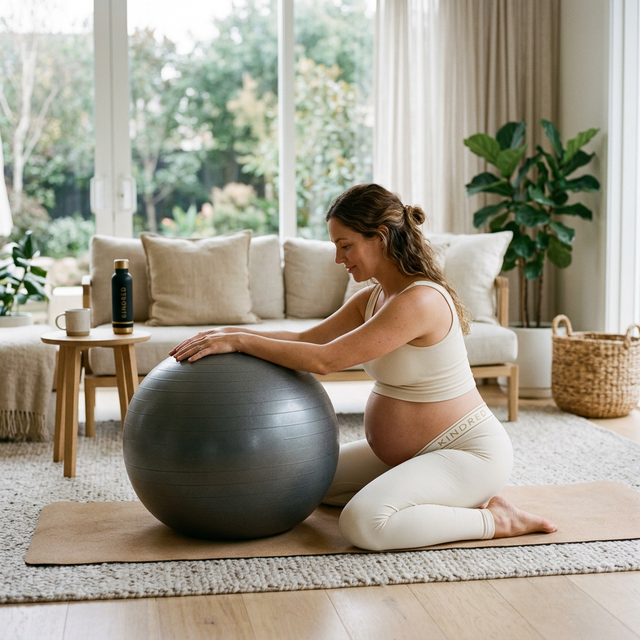
- Pilates ball (Swiss ball): A lifesaving prop in the third trimester! Sitting on a large ball (instead of a hard couch that tucks your tailbone under further), gentle hip circles, and stretching ease enormous pressure on your perineum and lower back.
For more detailed advice on how your core functions, we warmly recommend our guide: Why Kegels aren't enough.
3. The dynamics of labor: preparing the pelvic floor through release
When we talk about the pelvic floor, the fitness industry often focuses exclusively on strengthening and squeezing the base. For the act of vaginal birth itself, however, your ability to consciously release (eccentric control) those muscles matters just as much, if not more, than their strength.
A woman's pelvis has to "allow" the exit, not block it. If you've spent weeks doing nothing but squeezing, in the moment of peak tension your body may reflexively resist your own baby, which increases the risk of severe perineal tearing.
With the right, specific exercises, like a deep, supported sumo squat, asymmetric release exercises on all fours, or a child's pose with knees spread, you can train your muscles to consciously lengthen during contractions. All of this integrates into preparation with an emphasis on lateral (360°) breathing, which we teach our clients.
Not sure which exercises are safe and which are risky at this stage? Read our full General guide to exercising during pregnancy, or simply start working with a MyFittio specialist.
Here is where this trimester sits in the whole pregnancy:

4. Safety first: what to drop in the third trimester
Just as we mentioned earlier that adaptations are necessary, it's important to know which movements to avoid entirely after week 28:
- Heavy asymmetric loads: Deep lunges or Bulgarian split squats can worsen pubic symphysis pain. If you feel pinching at the front of your pelvis, swap asymmetric leg movements for bilateral ones (exercises with both feet firmly on the floor).
- The Valsalva maneuver: Never, ever hold your breath during effort (e.g., lifting a dumbbell). Holding your breath creates alarming, dangerous intra-abdominal pressure that worsens diastasis recti and weakens the pelvic floor. The golden rule is: exhale on effort!
- Levers and lying on your back: After week 16, prolonged lying on your back is avoided because of pressure from the uterus on the vena cava. In the third trimester, this rule is even stricter. Use an inclined bench, lie on your side propped with pillows, or use quadruped positions.
5. Why expert human guidance matters so much at this stage
In the last ten or so weeks of pregnancy, your anatomical capacity, energy level, and center of balance can change almost day to day. Generic plans (or AI apps) you downloaded often force you into rigid templates that become dangerous. An exercise that felt completely comfortable at week 26 can become physically unbearable at week 34, or trigger false (Braxton Hicks) contractions!
This is where the critical MyFittio advantage comes in. We've already written about the importance and limits of apps in our article on apps vs. online coaches.
Our NEPPE trainers communicate with you actively, asynchronously. If you wake up one morning with breathing difficulties, a strong feeling of heaviness in your vagina, or pinching in your lower back, you tell us. Your plan changes immediately. Heavy weights are dropped for that week, and the structure of your block shifts to light stretching, positioning to relieve your pelvis, diaphragmatic breathing, and relaxation on the ball.
Conclusion
It's well established (in line with ACOG guidelines) that controlled, supervised exercise in the third trimester reduces the risk of complications, proven to shorten the length of active labor, and dramatically speeds up postnatal recovery.
Don't spend the hardest part of this beautiful life stage in chronic pain, thinking "that's just how it has to be." Invest in your body. It's the only home your baby currently knows.
👉 Sign up now: fill out the MyFittio pregnancy questionnaire and give your body, your back, and your pelvis the kinesiological expert support they absolutely deserve in these final weeks.

MyFittio Team
NEPPE Certified Kinesiologists
Expert team of kinesiologists specialized in prenatal and postnatal programs, and body transformations. Our mission is to provide safe, science-backed support through every step of your health journey.
You might also like
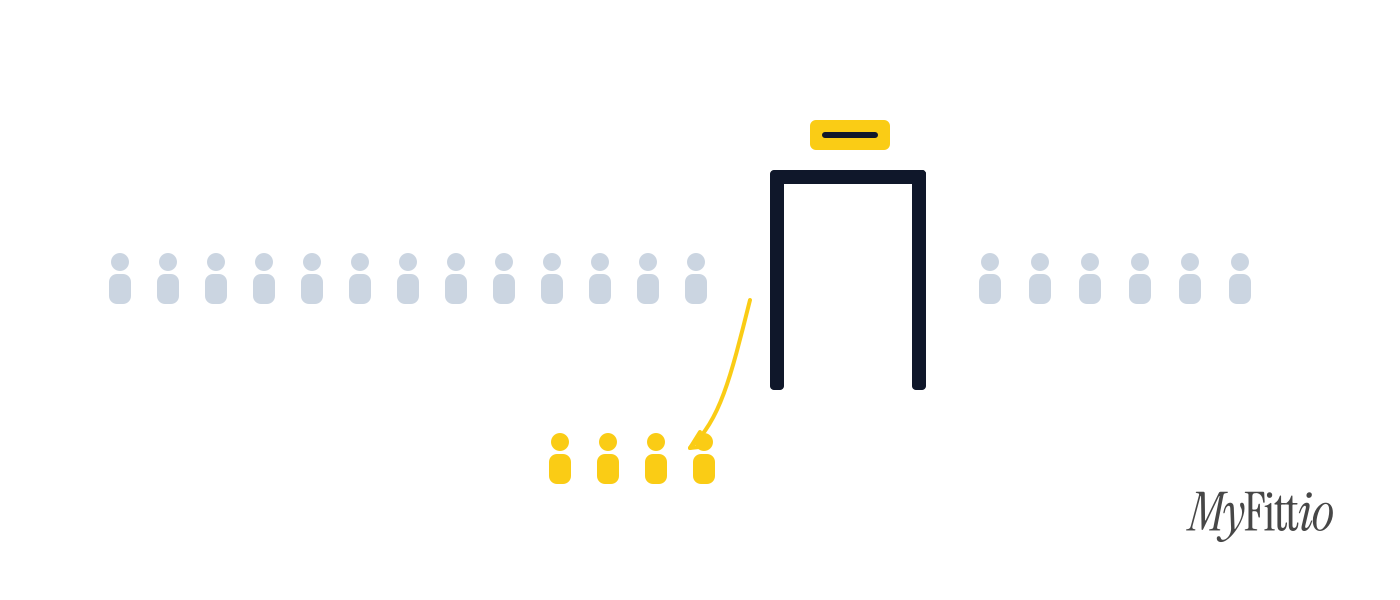
Pregnant, postpartum, diastasis or back pain: why most online programs do not want you, and what to do instead
There are 300 women on the stream. One of them is doing crunches with diastasis recti, and nobody knows.