
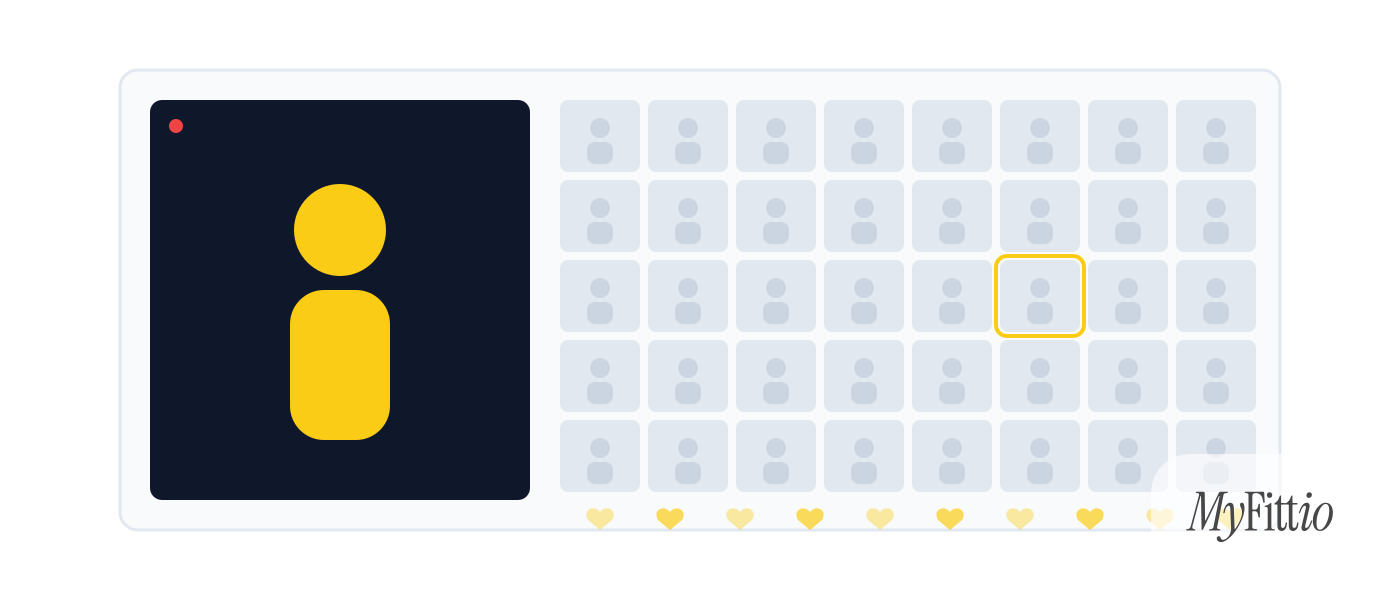
There are 300 women on the stream. One of them is doing crunches with diastasis recti, and nobody knows.
Tuesday, 7:58 pm. There are 312 women on the stream. The coach says hello, the camera is set, the first exercise is a warm-up on the spot. Names and hearts scroll up the chat.
At 8:14 pm come the crunches. Three sets of fifteen.
Somewhere in that group is a woman who gave birth eleven weeks ago. She got the green light from her gynecologist, she feels good, and this is her third workout since she "got back into it". On every lift of the shoulders off the floor, the middle of her belly domes into a cone. That is called coning, and it is a sign the abdominal wall is not coping with the pressure. She does not know that. The coach cannot see it, because the camera films the coach. The other 311 women cannot see it, because they are looking at the screen.
At 8:45 pm the workout ends. The chat says "well done, girls". She is pleased, because she made it through.
Nobody did anything wrong. And that is exactly the problem.
What the stream sees
Group online training is, technically, one-way video with a chat. That is not a criticism, it is a description. A camera films one person, hundreds watch and copy. The coach knows how many of you there are, sees who typed a comment, and sees who paid for the month. That is everything a stream can see.
It cannot see how you breathe. It cannot see whether your knee caves inward in a squat. It cannot see whether you hold your breath on every rep. It cannot see that you did the last three workouts with pain in your lower back, because you felt awkward typing that into a chat in front of 300 people.

For a healthy woman with no injuries, no pregnancy and no specific goal, this is mostly not a problem. The body forgives, the exercises are generic for a reason, and results come. The group format works for her, and works well.
The problem starts when one of those 312 women is different. And in a group of 312, there are always more different ones than one camera can keep track of.
Why it does not show in week one
If the difference between a group and a personal trainer showed up straight away, this article would not need to exist. But it does not show straight away. It shows up roughly like this:
Weeks 1 to 4. Everything works. Novelty, energy, results on the scale because the body is in a deficit for the first time in ages. The group is unbeatable here: a fixed slot, company, the feeling of being part of something.
Weeks 5 to 10. The first missed workouts. Nobody notices. Results slow down, which is normal, but nobody explains why. The knee pain that appeared in week three is now constant, so those exercises get "skipped".
Months 3 to 4. The scale stops. One of three things happens here: the woman quits, the woman makes peace with it, or the woman starts looking for "something else". The stream is still the same stream.

This chart is not from a study; it illustrates a mechanism. The group-energy curve starts high and falls as the novelty fades. The personal-accountability curve never climbs that high, but it does not fall either, because it does not depend on your mood but on the fact that someone specific is watching.
What "online personal trainer" actually means
The word "personal" often means very little in this context. An app that sends you a plan based on a questionnaire calls itself "personalized". A group program with five difficulty levels calls itself "tailored". So, to be clear about what we mean by it, and what you should look for no matter who you end up with:
Somebody assesses you before the first exercise. Not medically. A questionnaire and a conversation: injuries, surgeries, pregnancies and births, symptoms like leaking urine under strain, pain, downward pressure. If nobody asked, nobody knows, and the plan you got is not yours but somebody's.
The plan is written for you, and changes while you do it. Not chosen from five options. Written, with your schedule, the equipment you have at home, and the knee that has been bothering you since 2019. If something is off on Wednesday, the plan changes on Wednesday.
There is a person who answers. Not a bot, not a group, not "drop us an email". A kinesiologist you message when something hurts and who replies the same day with "stop doing that, do this instead, and send me a video".
Somebody notices you are gone. This is the least obvious one, and the most important.
Motivation, two kinds
There is a conventional split: the group gives motivation, the personal trainer gives expertise. That split is wrong, and it is worth taking apart, because people base their decision on it.
The group gives energy. Hundreds of people doing the same thing, a live chat, a coach who calls your name. That is a real mechanism and it works, especially in the first weeks when everything is new.
A personal trainer gives accountability. One person knows your plan, sees on Wednesday morning that Tuesday did not get done, and asks. If the reason is real, the plan adjusts. If it is not, you get a gentle nudge and you do it tomorrow.

The difference between those two mechanisms is not which one is stronger. It is which one lasts. Group energy depends on your mood and on whether you even logged in. Accountability to one person depends on nothing, because that person is watching whether you are there or not.
The group motivates you while you are on the stream. A trainer motivates you when you are not.
When the group is the better choice
It would be dishonest to write this article as if the personal trainer always wins. It does not.
Group online training is the better choice if:
- you are healthy, not pregnant, and have no injury that keeps coming back
- your goal is general tone and weight, with no specific requirement
- a fixed slot and company genuinely keep you going, and you know that about yourself
- your budget is under €30 a month and that is the only criterion
If that is your situation, find a group with a coach you like and stay. Honestly.
When a personal trainer is the better choice
An online personal kinesiologist is the better choice if:
- you are pregnant, or gave birth within the last year
- you have diastasis, pelvic floor weakness, back, knee or shoulder pain
- you have already been through one or two group programs and stalled in month four
- you need someone who will notice you have been gone for three days
With us, a program written for you by a kinesiologist starts at €59 a month, and the plan where the trainer is with you during the workout, correcting technique live, is €89. For comparison, one hour with a personal trainer in a gym costs about €25 in Croatia and two to three times that in most Western cities. Online is cheaper because the kinesiologist does not spend an hour traveling to you, not because they are less qualified.
Back to Tuesday
The woman with diastasis on the stream did nothing wrong. She got her doctor's approval, chose a program she liked, and did what she was told. In three months she will notice her belly is not coming back despite the training, maybe that she leaks when she coughs, and she will search Google for "diastasis exercises".
We hope she finds our article on it. We hope even more that next time, someone looks before she starts.
That is what a personal trainer is for. Not because they are smarter than the stream, but because they are looking at you, not at the camera.

MyFittio Team
NEPPE Certified Kinesiologists
Expert team of kinesiologists specialized in prenatal and postnatal programs, and body transformations. Our mission is to provide safe, science-backed support through every step of your health journey.
Your body is more complex than any calculator
A certified kinesiologist analyzes your unique situation and builds a program that actually works for your body type, lifestyle, and goals.
30-day money-back guarantee
You might also like
Pregnant, postpartum, diastasis or back pain: why most online programs do not want you, and what to do instead
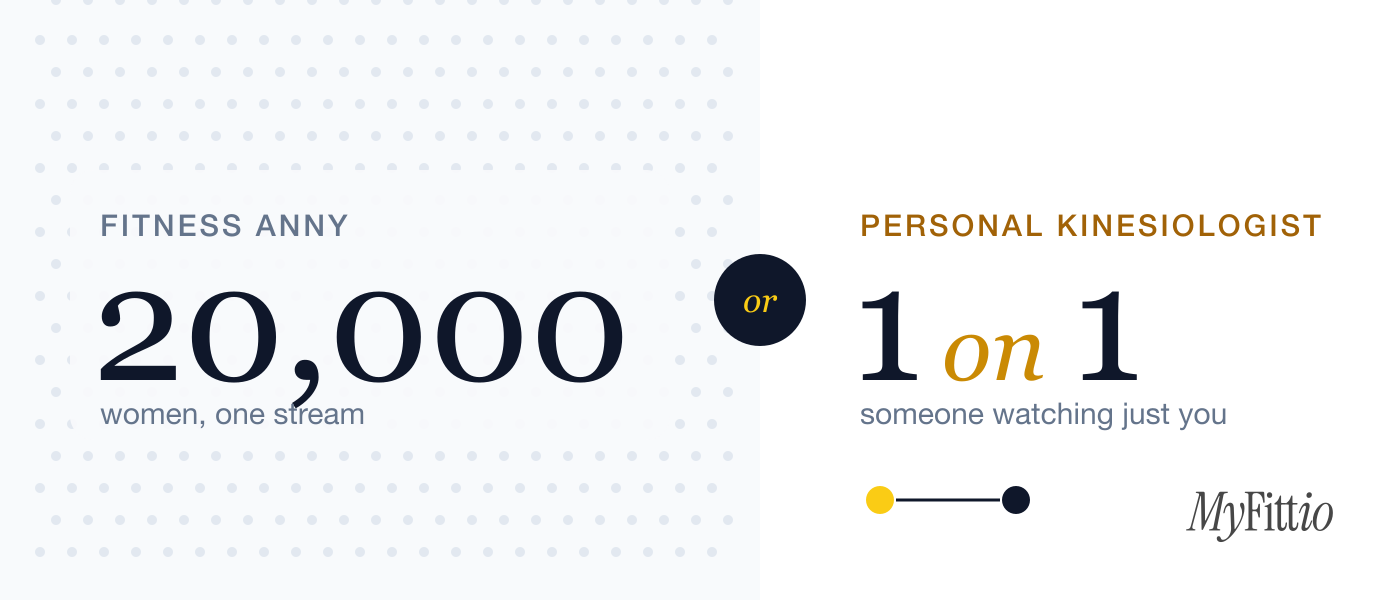
Fitness Anny has over 20,000 women. Here is when that is an advantage, and when it is not.