Online Pregnancy Workouts: How to Exercise Safely at Home
Wednesday, week 22 of pregnancy. Morning ritual: open the app, tap "Generate workout." Three sets of deep lunges appear on screen.
What the app doesn't know? Seven days earlier, pelvic pain started. A clicking sensation with every step that wakes her at night. Full-range lunges, at this stage, aren't just uncomfortable. They're potentially harmful.
But nobody tells the app that.
This isn't a made-up scenario. According to a study published in the journal MDPI, 93.3% of pregnant women use generic fitness apps like Strava, Nike Training Club, and MiFit. And when researchers reviewed 27 apps built specifically for pregnant women, they found something concerning: not one of the 27 screened users for health restrictions that would affect exercise. Only three had content aligned with medical recommendations.
Read this before you tap "Generate" next time.
What your gynecologist probably never told you
For a long time, the myth persisted that a pregnant woman should rest and take it easy. Modern research and ACOG (American College of Obstetricians and Gynecologists) guidelines completely dismantle that myth.
Moderate exercise during pregnancy is a medical recommendation with proven outcomes for labor and the health of both mother and baby, not simply a nice-to-have.
A 62-minute difference
A review of 60 different clinical studies looked at how exercise during pregnancy affects labor. In women who exercised, the first stage of labor was on average 62 minutes shorter, and the risk of a C-section was 13% lower. Exercise made no significant difference to epidural use, and that is worth saying just as loudly. In one specific trial of 290 pregnant women: 15.9% C-sections in the exercise group, versus 23% in the non-exercise group.

Nobody runs a marathon without training. Labor is physically one of the most demanding moments in a woman's life. Why would anyone go into it with zero preparation?
Three times less postpartum depression
In a randomized trial of 398 pregnant women (BJOG, 2025), women exercised three times a week for an hour. Three months after birth, postpartum depression affected 6% of the women who exercised, versus 20% in the control group. That depression affects between 10 and 15% of mothers in the first year. These aren't just numbers. These are women fighting, exhausted and alone, at one of the most important moments of their lives, in situations that could have been prevented.
Why apps aren't enough
Back to the opening scene. It's not a coincidence that situations like that happen.
Researchers reviewed 27 apps for pregnant women. Not one asked whether the user had any health restrictions, like a low-lying placenta, risk of preterm birth, or pelvic pain, where certain exercises should be removed immediately. That's not a small oversight. It's a fundamental problem.
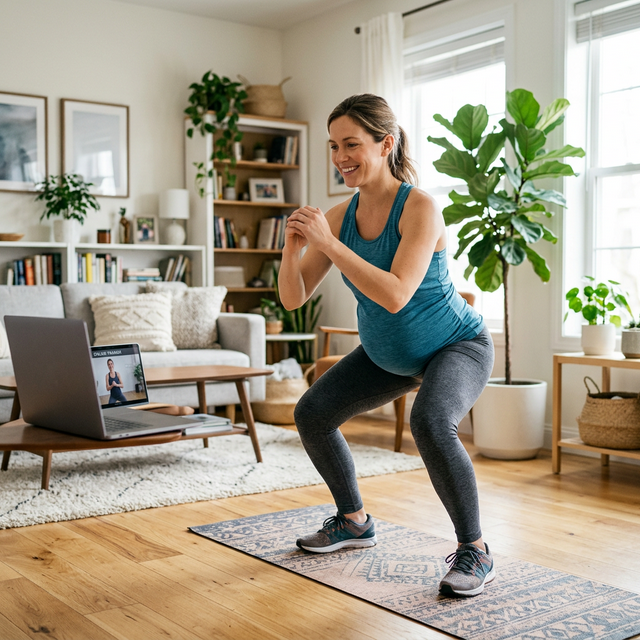
The app can't see what you're doing. When you do a squat at 26 weeks pregnant, your body is starting to adapt to a growing belly. Your hips go too far back, your back loses good positioning. Research shows that more than 60% of people who exercise unsupervised do exercises with incorrect technique. For pregnant women, whose bodies change week to week, that's an even bigger problem. The app doesn't see it. It can't stop you. And it doesn't know what hurts this particular Wednesday morning.
Hormones change everything. Relaxin is a hormone that loosens the ligaments in your body so your pelvis can accommodate a baby. It peaks at the end of the second trimester. An exercise that was perfect at 26 weeks can trigger false labor or worsen pelvic pain at 34 weeks. The plan the app generated for you never adapted to that.
And here's perhaps the strongest argument:

According to industry data, out of 100 people who install a fitness app, only 3 to 4 still open it after a month. The best apps keep more, but that is the average. And all the benefits of exercising during pregnancy require one thing: continuity. Without it, there's nothing.
What "online pregnancy workouts" actually covers
When someone searches that phrase, they get the same chaos: YouTube channels with real certifications, free apps mixed in with medical platforms. It's worth knowing the difference.
YouTube is fine for the occasional morning stretch or breathing yoga session. But a channel with 500,000 followers could just as easily be run by an educated trainer as by someone with zero qualifications who "had a nice pregnancy." Visually, it looks identical. It's not enough for serious, structured prenatal training.
Generic apps with a "pregnancy mode" like Nike Training Club or Peloton add a "pregnancy" toggle. In 95% of cases, that actually just means the most intense workouts are disabled and a "consult your doctor" disclaimer is added. That's not a prenatal program.
Specialized prenatal apps are a step forward. They're built specifically for pregnant women, with programs developed with physical therapists. They're affordable and relatively safe. But there's still no one watching how you specifically perform an exercise, and the plan stays the same for your week of pregnancy regardless of how you actually feel.
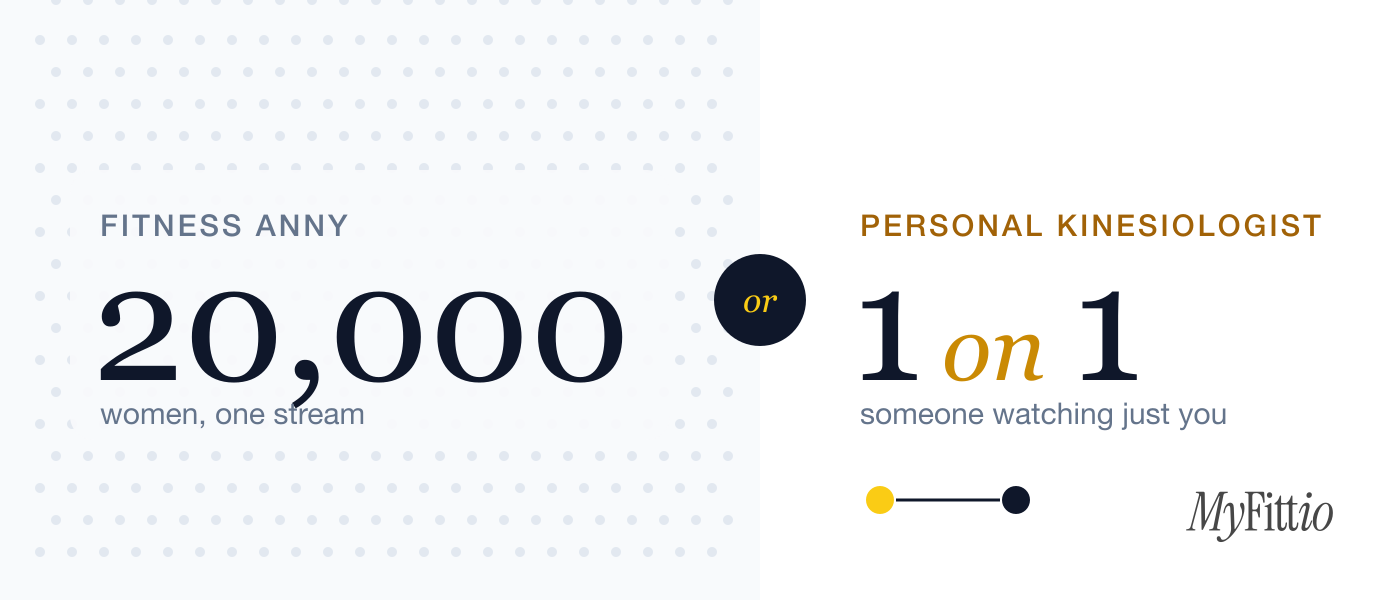
One-on-one online coaching with a certified kinesiologist is the only model that actually replicates what's been proven in studies: individual, supervised training that just happens to take place online instead of at a gym.

What every good online prenatal program needs
Every serious program starts with a detailed questionnaire: week of pregnancy, previous pregnancies, your gynecologist's recommendations, any pain, exercise history, specific conditions that change what you're allowed to do. Without that, there's no safe plan. That's exactly what none of the 27 reviewed apps had.
Then comes weekly adaptation. Your body changes weekly, not monthly. When you report new pain or get new information from your gynecologist, the plan needs to change. That requires real communication with a coach, not an automated app message.
Feedback on your technique matters too. Record yourself doing a squat and send it to your kinesiologist. She checks: is your back in a good position, are you engaging your glutes on the way up, are you breathing on effort? That feedback prevents problems that quietly build up over weeks until one day they turn into chronic back pain.
And finally, a program that follows you from the first trimester through postpartum recovery is the only one that truly makes sense. Exercises need to keep adapting to the increasing load on your pelvic muscles, the shift in your center of gravity, and the hormonal changes in every trimester.
Fill out the MyFittio pregnancy questionnaire, and our certified kinesiologists will assess your condition and build a plan for your pregnancy, week by week. Fill out the questionnaire →
5 exercises you can start doing today
This is a guideline, not a substitute for an individual plan. Always consult your gynecologist or a certified kinesiologist.
Diaphragmatic breathing (all stages of pregnancy)
This is the foundation of everything. It teaches your body how to manage pressure in the abdomen, which is key for pelvic muscle health and preventing abdominal separation.
Lie on your side or sit. On the inhale, let your ribs expand in all directions. Don't push your belly outward. On the exhale, gently "draw" your pelvic floor inward. That's real activation of those muscles, without aggressive clenching.
Goblet squat (1st and 2nd trimester)
Strengthens your glutes, which counterbalance the belly pulling your body forward and causing back pain. Stand wider than hip-width, toes turned slightly out. Hold a dumbbell in front of your chest. Lower slowly with your knees over your feet. Exhale and squeeze your glutes as you rise. Don't hold your breath. If you feel pelvic pinching, reduce your range of motion.
Bird-Dog (all stages of pregnancy)
One of the few core-strengthening exercises that's safe throughout pregnancy, with no pressure on the front of the abdomen. Get on all fours. Simultaneously lift your left arm and right leg to hip height. Hold two to three seconds without rotating your hips. If you notice doming down the middle of your belly, reduce the intensity and check in with a professional.
Glute bridge (1st and 2nd trimester)
Strengthens your glutes without loading your abs. Lie on your back, knees bent. On the exhale, gently activate your pelvic muscles and lift your hips. Hold two seconds at the top, then lower slowly. After week 16, avoid lying on your back for long periods; modify with an incline bench, or stand and use a resistance band instead.
Hip circles on a Pilates ball (3rd trimester)
Reduces pressure on your pelvic floor and lower back, encourages your baby to descend, and prepares your pelvic muscles to release during labor. Sit on the ball, feet apart. Gentle hip circles in both directions. Focus on your breathing.
Questions we get most often
"I trained intensely before. Can I keep going?"
Yes, with adaptation. But adaptation doesn't mean drastically scaling back. ACOG recommendations say you should modify exercises for the changes in your body, not necessarily reduce intensity. A good test: can you hold a conversation while exercising? Remember just one thing: your body is now doing two jobs at once, so the same effort will feel harder than it used to.
"Can I use apps with a bit of common sense?"
Common sense isn't enough when you can't tell the difference between round ligament pain and pelvic floor dysfunction pain, because one of those two situations calls for the exact opposite exercise from the other.
"What's the minimum I need for home workouts?"
A yoga mat, a 65 cm Pilates ball, and a set of light dumbbells from 1 to 5 kg. A resistance band if you can find one. Between 80 and 150 euros total. With that, a certified trainer can build a safe plan for your entire pregnancy and recovery.
Bottom line
Pregnant women who exercise have a shorter first stage of labor, fewer C-sections, and less postpartum depression. But only if they exercise safely and consistently, with someone who understands what's happening in their body that specific week.
None of the 27 apps reviewed asked about health restrictions. After a month, only 3 to 4 out of 100 people who installed the average fitness app still open it. A real online prenatal program isn't an app. It's an expert who follows you and adapts the plan to your body, not to the week of the year.
👉 Fill out the MyFittio pregnancy questionnaire →
Scientific references
- López-González, D.M. et al. (2023). Prenatal exercise and labor outcomes: Systematic review and meta-analysis of 60 RCT studies. MDPI Sports Medicine.
- Davenport, M.H. et al. (2019). Prenatal exercise for the prevention of gestational diabetes mellitus and hypertensive disorders of pregnancy. British Journal of Sports Medicine.
- ACOG Committee Opinion #804. Physical Activity and Exercise During Pregnancy and the Postpartum Period. American College of Obstetricians and Gynecologists, 2020 (reaffirmed 2023).
- Guszkowska, M. et al. (2023). Exercise as prevention of postpartum depression: Meta-analysis of randomized controlled trials. National Library of Medicine (PubMed).
- Haakstad, L.A.H. et al. (2022). Mobile health apps for pregnancy: systematic review of 27 applications and alignment with public health guidelines. University of Alberta / PubMed.
- Business of Apps (2024). Fitness App Retention Rates and User Engagement Statistics.
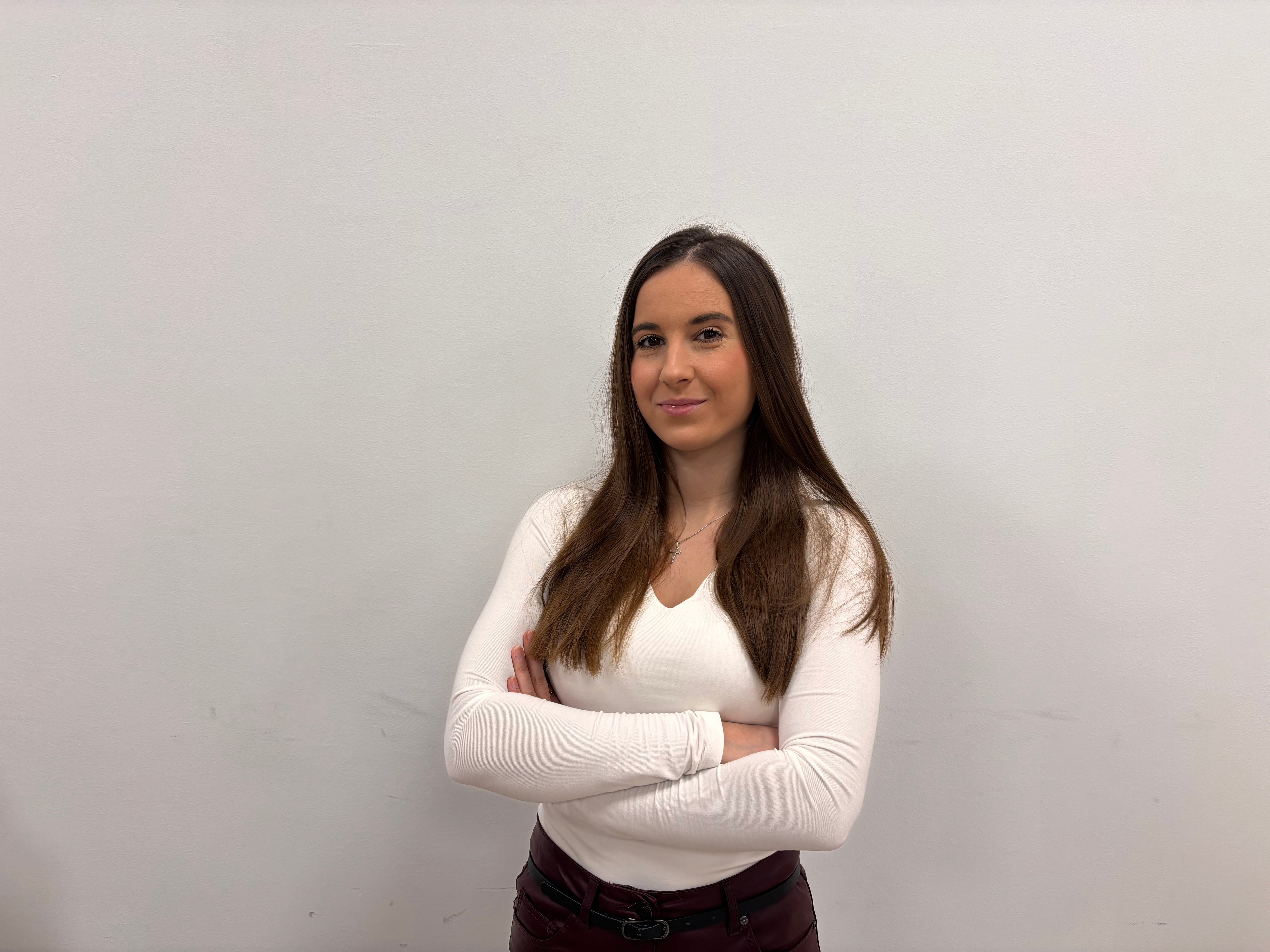
MyFittio Team
NEPPE Certified Kinesiologists
Expert team of kinesiologists specialized in prenatal and postnatal programs, and body transformations. Our mission is to provide safe, science-backed support through every step of your health journey.
You might also like
Pregnant, postpartum, diastasis or back pain: why most online programs do not want you, and what to do instead
There are 300 women on the stream. One of them is doing crunches with diastasis recti, and nobody knows.